

Technical Support:
158-7527-1139


In modern society, with the improvement of people's living standards, the attention to indoor air quality is increasing day by day. Among them, formaldehyde, as a common indoor pollutant, has an important impact on human health. In order to monitor formaldehyde concentration in time, formaldehyde sensors came into being. This article will explore the working principle and detection methods of indoor formaldehyde sensors.
The working principle of indoor formaldehyde sensors is mainly based on two technologies: photoelectric absorption and gas-sensitive resistance.
First, photoelectric absorption technology utilizes the absorption characteristics of formaldehyde molecules for specific wavelengths of light. The sensor emits a light source of a specific wavelength. When the light passes through air containing formaldehyde, the formaldehyde molecules will absorb the light energy, causing the light to weaken. By detecting the change in light intensity, the sensor can calculate the concentration of formaldehyde in the air.
Secondly, gas-sensitive resistance technology utilizes the principle that chemical reactions between formaldehyde molecules and the surface of specific materials lead to changes in resistance. The inside of the sensor contains a gas-sensitive resistor element, the surface of which is usually coated with nanomaterials or semiconductor materials. When the formaldehyde concentration in the air changes, formaldehyde molecules will react with the material surface, leading to a change in resistance value. By measuring the change in resistance, the sensor can accurately detect the concentration of formaldehyde.
By comprehensively utilizing photoelectric absorption and gas-sensitive resistance technologies, indoor formaldehyde sensors can achieve accurate detection of formaldehyde concentration.
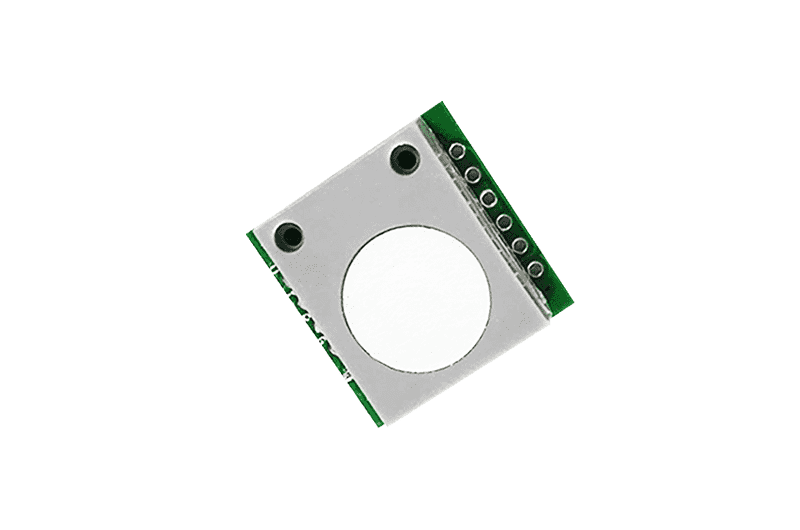
In practical use, indoor formaldehyde sensors can adopt the following detection methods:
● Real-time Monitoring Method: The sensor continuously monitors the formaldehyde concentration in the air and feeds the data back to the user in real time. This method can detect formaldehyde exceeding standards in time and remind users to take corresponding measures.
● Timing Detection Method: The user sets the detection time interval, and the sensor detects the formaldehyde concentration in the air at preset time points. Although it cannot provide real-time monitoring, it can effectively save energy and extend the service life of the sensor.
● Alarm Detection Method: When the formaldehyde concentration in the air exceeds the preset safety threshold, the sensor will issue an alarm signal to remind the user to pay attention to air quality issues and take measures to improve the environment in time.
Through the application of the above multiple detection methods, indoor formaldehyde sensors can meet the needs of different users and effectively guarantee indoor air quality.
Based on photoelectric absorption and gas-sensitive resistance technology, indoor formaldehyde sensors can accurately and in real-time monitor the concentration of formaldehyde in the air. In practical use, different detection methods can be selected according to needs to ensure that indoor air quality reaches safety standards and protects people's health.
