

Technical Support:
158-7527-1139


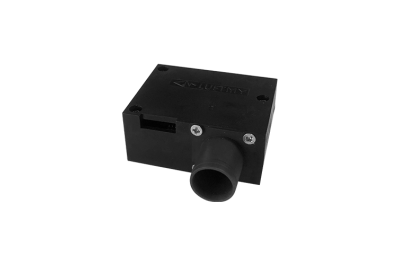
LF10 is a sensor that does not require an internal fan; its driving air source comes from the host device, improving on defects caused by fans. It features a high-intensity uniform light sensing area within a scattering chamber.
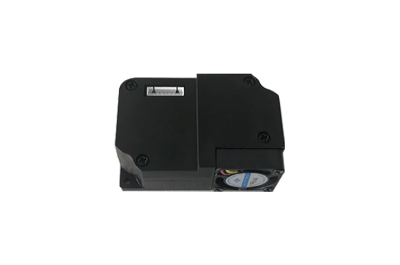
The LD19 is a high-precision particulate matter concentration sensor based on the Laser Mie Scattering theory. It can continuously collect and calculate the number of suspended particles of different sizes in the air per unit volume—namely the particulate matter concentration distribution—and convert this into mass concentration, outputting it via a universal digital interface. This sensor can be embedded in various instruments or environmental improvement equipment related to suspended particulate concentration to provide timely and accurate data.
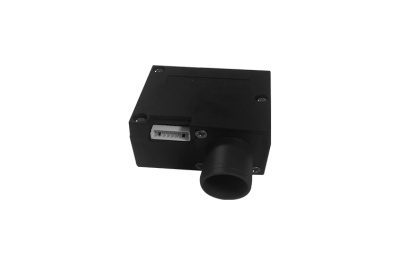
The LF12 is a sensor that does not require an internal fan; its driving air source comes from the host device, which overcomes the defects caused by fans in traditional laser sensors on the market. A high-illuminance and uniform light-sensitive area is set in the center of the scattering cavity inside the housing. A semiconductor laser generator and detector are set outside the scattering cavity. The detector is connected via an amplification circuit to a microcontroller unit that can calculate the particle diameter and quantity based on the amplification circuit’s input signals.
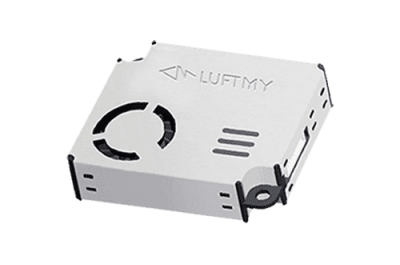
The LD15T integrated sensor module outputs temperature, humidity, and PM1.0/2.5/10 data. Stable, metal-shielded, and compact, it is suitable for high-end appliances and air quality detectors.
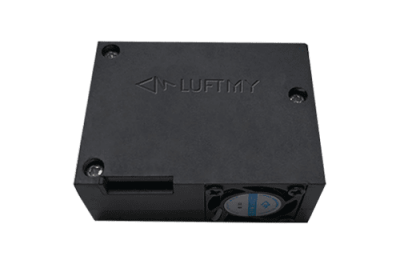
The LD10 laser dust sensor series is a high-temperature resistant, long-life laser dust sensor. Based on optical scattering and LUFTMY's unique dust source identification technology, it accurately detects particle counts across sizes in unit volumes. It outputs accurate PM2.5 concentrations via mathematical algorithms and scientific calibration. The conductive shell effectively shields electromagnetic interference.
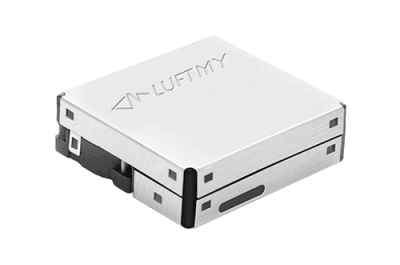
The LD09 series is a high-temperature resistant, long-life, ultra-thin laser dust sensor. Based on the principle of optical scattering and combined with LUFTMY's unique dust source intelligent identification technology, it can accurately detect and calculate the number of particles of different sizes in a unit volume across various environments. Through mathematical algorithms and scientific calibration, it achieves accurate PM2.5 mass concentration output. The full metal shell effectively shields electromagnetic interference.
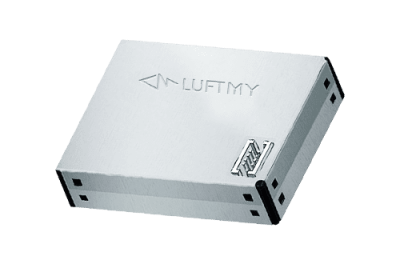
The LD11 series is a high-temperature resistant, long-life, ultra-thin laser dust sensor. Based on the principle of optical scattering and combined with LUFTMY's unique dust source intelligent identification technology, it can accurately detect and calculate the number of particles of different sizes in a unit volume across various environments. Through mathematical algorithms and scientific calibration, it achieves accurate PM2.5 mass concentration output. The full metal shell effectively shields electromagnetic interference, providing excellent anti-interference performance.
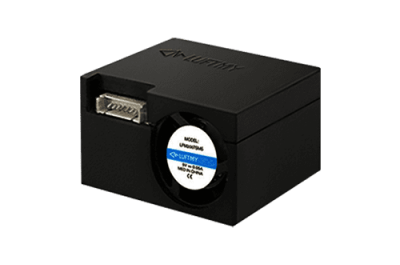
LD12 series is a high-temperature resistant, long-life laser dust sensor. Based on optical scattering and Luftmy's unique dust source identification technology, it accurately calculates suspended particles of different sizes.
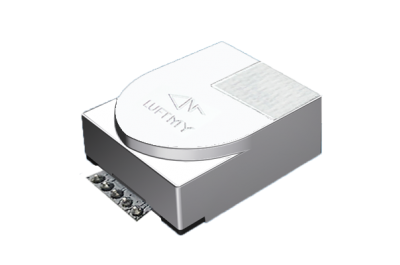
The CO208 dual-channel infrared carbon dioxide sensor is a dual-channel NDIR sensor. The development of the dual-channel technology is based on the unique absorption characteristics of CO₂ gas. The signal of the measurement channel varies with changes in CO₂ concentration, while the signal of the reference channel is affected only by sensor drift. The reference channel performs real-time compensation for the measurement channel, ensuring stable and reliable measurements during long-term operation.
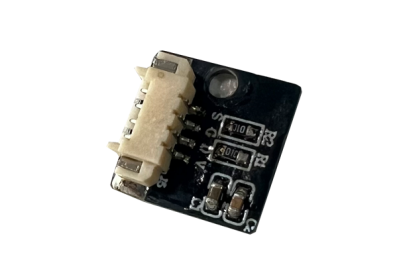
The MTHO3A1 temperature and humidity sensor module, based on a MEMS gas-sensing element, is used to measure ambient temperature and humidity as well as the concentration of harmful substances in the air. Measurement data are transmitted via I²C or UART interfaces. The surface of the MEMS gas-sensing element can be protected with a filter membrane, and the air quality sensor module can be assembled using either a plug-in board or SMT mounting, depending on requirements.
