Technical Support:
158-7527-1139

Sensing technology plays a vital role in modern science, medicine, environmental monitoring, and engineering fields. In the field of sensing, semiconductor sensors and electrochemical sensors are two common technologies. This article will compare the performance, application areas, and working principles of these two sensors to help you better understand the differences between them.

I. What is a Semiconductor Sensor?
A semiconductor sensor is a sensing technology that uses semiconductor materials as sensing elements. Its working principle is based on the electrical properties of semiconductor materials, especially resistivity and conductivity. Here are some key characteristics of semiconductor sensors:
1. Performance and Application:
● Fast Response: Semiconductor sensors usually have fast response times and can be used for real-time monitoring.
● High Sensitivity: They are very sensitive to small concentration changes of target compounds, suitable for gas detection, chemical analysis, etc.
● Temperature Influence: Temperature changes may affect the performance of semiconductor sensors, requiring temperature compensation techniques.
● Application Areas: Common applications include environmental monitoring, gas detection, air quality monitoring, and food safety testing.
2. Working Principle:
The working principle of a semiconductor sensor is based on changes in conductivity. When target molecules interact with the semiconductor surface, the conductivity changes, and this change can be used to detect the presence or concentration of the target molecules.

II. What is an Electrochemical Sensor?
An electrochemical sensor is a sensing technology that uses electrochemical principles to detect analytes. Its working principle involves the measurement of current and potential, typically involving electrochemical electrodes. Here are some key characteristics of electrochemical sensors:
1. Performance and Application:
● High Selectivity: Electrochemical sensors can identify and measure target molecules very specifically, making them very useful in the field of chemical analysis.
● Interference Tolerance: They are relatively less affected by interfering substances and can be used for analysis in complex matrix samples.
● Low Cost: Electrochemical sensors typically have relatively low manufacturing costs, suitable for large-scale applications.
● Application Areas: Electrochemical sensors are widely used in biosensing, drug analysis, environmental monitoring, and medical diagnosis.
2. Working Principle:
The working principle of an electrochemical sensor is based on changes in electrode potential. When target molecules undergo a chemical reaction at the electrode surface, the potential changes, and the concentration of the analyte can be detected by measuring current or potential.
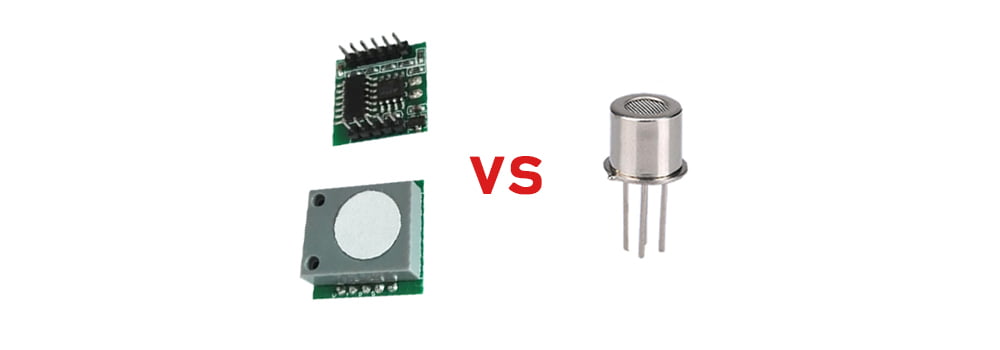
III. Differences Between the Two:
● Performance and Application Differences: Semiconductor sensors are usually more suitable for fast-response gas detection applications, while electrochemical sensors have more advantages in chemical analysis and biosensing.
● Sensitivity and Specificity: Semiconductor sensors are generally sensitive to multiple gases, whereas electrochemical sensors can detect target molecules with greater specificity.
● Influence of Interfering Substances: Electrochemical sensors are relatively less affected by interfering substances, while semiconductor sensors may be more sensitive to environmental factors such as temperature and humidity.
● Cost: Electrochemical sensors typically have relatively low manufacturing costs, while semiconductor sensor prices vary depending on the model and performance.
Both semiconductor sensors and electrochemical sensors have their own advantages in different application fields. The choice of sensor depends on your specific needs, including performance, specificity, cost, and application environment. Understanding their working principles and performance differences helps in making an informed choice to meet your analysis and detection requirements. We hope the information provided in this article helps you better understand the differences and advantages of these two sensing technologies.