

Technical Support:
158-7527-1139

In daily life, various living and office activities such as housework, movement of people, cooking, smoking, and printing will more or less increase the concentration of indoor dust particles; in addition, pets, emissions from various indoor decorative surfaces, and various microorganisms bred in the indoor environment are also sources of indoor particles.
According to research data from relevant institutions, the cooking process produces 4.1±1.6mg of inhalable particulate matter per minute, of which PM2.5 accounts for about 40%, with a quantity of 1.7±0.6mg. The majority of the particle sizes produced by cooking activities are below 0.5μm. Particles released by cigarette combustion in environments such as offices account for about 50%-80% of indoor particles, and as high as 80%-90% in meeting rooms and lounges. Cigarette combustion can release 1.67mg of fine particles per minute, of which the weight-based generation rate of particles with a diameter smaller than 2.5μm is 0.99mg/min, and the count-based generation rate of particles below 1μm is 1.92×10¹¹ particles/min. Chemical reactions between indoor pollutants such as ozone and terpenes also produce new particulate matter, increasing the concentration of indoor particles by about 2.5-5.5μg/m3.
1. Why Detect Dust Particles
After dust particles enter the human body through the respiratory system, the location where they are deposited is determined by the particle size. The smaller the particle size, the deeper it enters the body, thereby affecting the health of vital organs such as the heart and brain.
①. Coarse particles of 2.5-10μm are deposited in the upper respiratory system such as the throat and trachea;
②. Fine particles of 1-2.5μm are deposited in the lower respiratory system such as the bronchi;
③. Finer particles of 0.1-1μm can enter the lungs;
④. Ultrafine particles smaller than 0.1μm can directly penetrate the alveoli and enter the human blood circulation system.
The smaller the particle size, the larger the corresponding number concentration and total surface area. Relatively speaking, its surface can adsorb more toxic and harmful substances such as organic pollutants (such as polycyclic aromatic hydrocarbons), acidic oxides, heavy metals, viruses, and fungi. Therefore, the smaller the particle size, the greater the harm to human health.
Dust particle prevention and control are mainly divided into two aspects: detection and governance. Only by achieving effective detection of environmental dust can targeted governance plans be implemented, thereby improving people's living and working environments and staying away from the hazards of air pollution particles.
2. Dust Particle Concentration Detection Methods
①. Infrared light scattering method for measuring dust mass concentration. Currently, domestic and foreign measurement methods can be roughly divided into the weighing method, light scattering method, β-ray method, and so on. Among these methods, the light scattering method has the advantages of fast detection speed, good repeatability, and timely data processing, and is widely used in dust concentration detection. Light scattering refers to the phenomenon where light deviates from its original propagation direction and spreads in all directions when passing through an uneven medium. Dust particles generate scattered light when illuminated by light. Larger particles produce stronger scattered light signals, and the intensity of scattered light is proportional to the particle size. When light passes through a medium, it interacts with the medium. In addition to being scattered, it is also absorbed by the medium, and the absorption relationship conforms to the Beer-Lambert law of infrared absorption. When parallel light passes through a uniform medium, based on the Beer-Lambert law, the dust concentration is obtained by measuring the incident light intensity and the outgoing light intensity and then calculating.
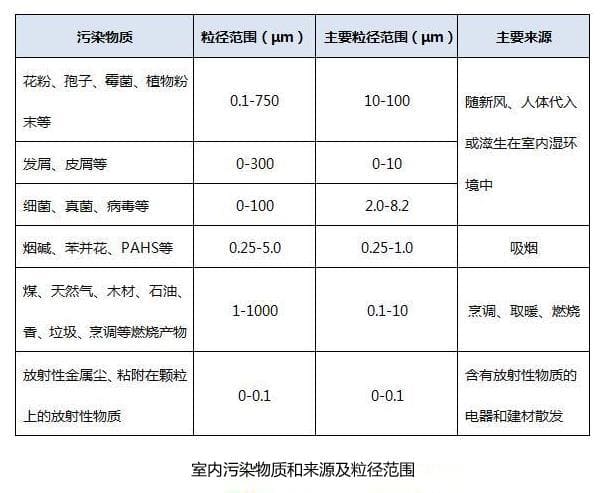
②. Detection of small particle size matter. As shown in the figure above, in people's daily lives, some small particle size indoor pollutants are generated. Traditional infrared dust detection technology can only detect particles above 1μm, uses only heating resistors to drive the sampling airflow, has a small number of samples, and the data calculation is completely handled by the upper computer, resulting in relatively insufficient measurement accuracy. With in-depth research on infrared light sources and sensor technology, the industry has improved and upgraded infrared dust sensors, developing an infrared dust detection technology that can accurately detect small particle size matter.
3. GDS06 Infrared PM2.5 Sensor
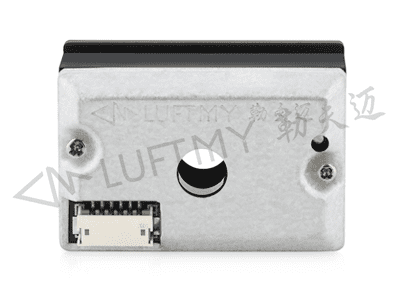
The GDS06 infrared PM2.5 dust sensor uses the principle of optical scattering to obtain the concentration of particulate matter. Because particles and molecules produce light scattering when illuminated, they also absorb part of the energy of the incident light. When a beam of parallel monochromatic light is incident on the measured particle field, it will be affected by scattering and absorption around the particles, and the light intensity will be attenuated. The relative attenuation rate of the incident light through the concentration field to be measured can be obtained. The relative attenuation rate basically reflects the relative concentration of dust in the field to be measured linearly. The intensity of light is proportional to the strength of the photoelectric-converted electrical signal. By measuring the electrical signal, the relative attenuation rate can be obtained, and then the concentration of dust in the field to be measured can be determined. Then, a microcontroller is used for PWM and UART communication.
Application areas of Luftmy infrared sensors: air conditioners, air purifiers, automotive purification equipment, portable detectors, fresh air systems, intelligent detectors, etc.
