

Technical Support:
158-7527-1139

With the continuous improvement of people’s living standards and the increasing health awareness of the whole people, air quality monitoring and air purification products are receiving more and more public attention! However, driven by the huge consumer market, the domestic air purifier market is developing rapidly, with fierce competition between old and new brands. This has also prompted the domestic dust sensor market to constantly release new products; no dust sensor manufacturer would want to miss the chance to stand out in such a great environment! Judging from the publicity of various manufacturers for their products, they all focus on highlighting the advantages of their own dust sensor products, which is beyond reproach; but sometimes it is inevitably biased and lacks objectivity. Regarding which kind of dust sensor should be used in air purifiers, let’s talk about it from the perspective of user experience and value creation.
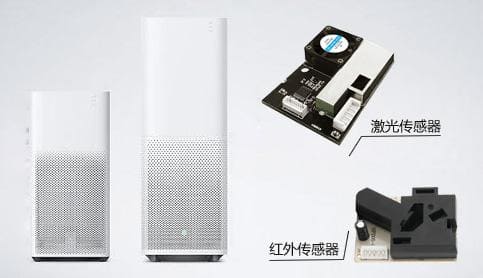
Laser dust sensor and Infrared dust sensor:
1. The English word LASER is an acronym derived from the phrase “Light Amplification by Stimulated Emission of Radiation.” Laser actually refers to the light produced by utilizing the special physical phenomenon of “stimulated emission to produce light amplification.” Putting aside obscure physical academic terms, compared with ordinary visible light, lasers have the characteristics of: high coherence, strong directionality, good monochromaticity, and high power density. Common lasers are generally divided into three categories: solid-state lasers, gas lasers, and semiconductor lasers (commonly known as laser LEDs).
2. In the field of dust sensors, due to cost constraints, laser LEDs are generally used as the light source. Infrared LEDs are light-emitting diodes that emit wavelengths in the infrared segment, with common wavelengths generally around 850nm~940nm. Since the emission wavelength of infrared LEDs is outside the visible spectrum, combined with a specific spectral receiver, the influence of ambient light on the received signal can be significantly weakened. Thanks to the continuous maturity of infrared LED technology in recent years, infrared LEDs have the characteristics of: long life, high emission efficiency, good monochromaticity, and good directionality. This makes infrared LEDs widely used in the sensor field, especially in the dust sensor industry.
In the current field of PM2.5 dust particle detection, two types of dust sensors are mainly used: infrared dust sensors and laser dust sensors. What are the differences and questions between the two? Luftmy editor briefly introduces them from five aspects:
1. Structure and principle of dust sensors
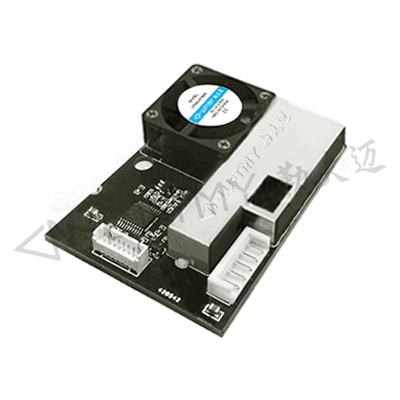
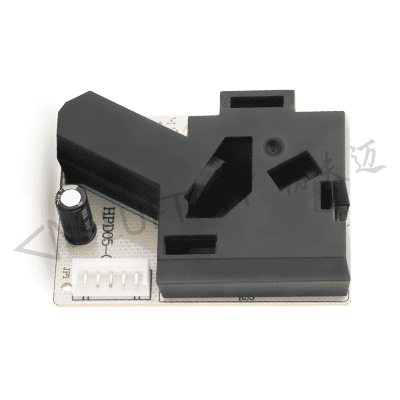
The structure and circuit of the infrared dust sensor are relatively simple. Its light source is an infrared LED light source. The airflow inlet and outlet mainly rely on resistance heating to obtain thermal airflow. When particles pass through, a high level is output. The output signal is only a PWM model. The structure and circuit of the laser sensor are relatively complex. Its light source is a laser diode. The sampling air is pushed by a fan or blower and passes through a complex designed air duct for detection. When the fine particulate matter in the air enters the area where the laser beam is located, it will cause the laser to scatter; the scattered light radiates in 360° in space. We place a photodetector at an appropriate position so that it only receives the scattered light, and then generates a current signal through the photoelectric effect of the photodetector. After circuit amplification and processing, the concentration value of fine particulate matter can be obtained. The output signal is generally a serial port output.
2. Measurement accuracy of dust sensors
Infrared dust sensors can only detect particles above 1um, and the measurement accuracy is insufficient. Because the signal of particles scattered by infrared LED light is weak, it only responds to large particles larger than 1um, and only uses heating resistors to drive the sampling airflow, the number of samples is small, and data calculation is entirely left to the host computer. The laser dust sensor can detect particles above 0.3um. Because it comes with a high-performance CPU and uses fans or blowers to collect large amounts of data, which are analyzed by professional particle counting algorithms; in summary, it has advantages over infrared dust sensors in three aspects: sampling count, data source, and algorithms.
3. Price and cost of dust sensors
Infrared dust sensors have been maturely used in the industry for many years, with a market price of about 35-50 yuan, while laser dust sensors have a market price of 90-180 yuan. The cost gap between the two is mainly because the latter’s material cost includes added components such as laser generators and fans, and requires a complex circuit structure with a high technical threshold.
4. Application occasions for dust sensors
Due to insufficient precision, infrared principle sensors are mainly used for industrial and mining dust, where the detection objects are large-diameter, high-concentration dust, and the detection level is mg/m3, making it impossible to accurately measure the concentration of PM2.5. Laser principle sensors are mainly used in the PM2.5 detection field to quantify PM2.5 quality with precision. They can be embedded in household (vehicle, handheld) air detectors and air purifiers. In addition, laser principle sensors are also used in IoT data collection and environmental quality detection.
5. Development trends for dust sensors
Before laser dust sensors entered the civilian field, infrared dust sensors were widely used in air purifiers. However, with the development of the air purifier industry, coupled with the mass production of laser dust sensors by some large factories, the cost of laser dust sensors is gradually decreasing, while end customers’ requirements for accurate air quality measurement are getting higher and higher. Using laser principle sensors to accurately quantify PM2.5 quality has become a recognized trend in the industry.
Luftmy LD13 laser dust sensor is a high-precision particulate matter concentration sensor based on Laser Mie scattering theory. It can continuously collect and calculate the number of suspended particles of different particle sizes in the air per unit volume, i.e., the particulate matter concentration distribution, and then convert it into mass concentration and output it in the form of a general digital interface. This sensor can be embedded in various instruments or environment improvement equipment related to the concentration of suspended particles in the air to provide timely and accurate concentration data. This sensor is suitable for air purifiers, air conditioners, PM2.5 detectors, range hoods, fresh air systems, dedicated PM2.5 sensors, air detectors, etc.
Luftmy HPD05 infrared PM2.5 sensor module uses the optical scattering principle to detect the concentration of dust in the air. The sensor has a built-in infrared light-emitting diode and a high-sensitivity photoelectric receiving sensor. The infrared light-emitting diode emits light that generates reflected light when encountering dust. The photoelectric sensor reflects the dust concentration in the air by detecting the intensity of the reflected light. The sensor directly outputs a PWM signal, where the PWM width is the current concentration value (1ms = 1ug/m3). It can also output the dust concentration value through an IIC serial port signal, with the unit being ug/m3. This sensor is suitable for air purifiers, air conditioners with purification functions, fresh air systems, and supporting air quality testing instruments.
