Technical Support:
158-7527-1139

A laser power sensor is a detector that absorbs a laser beam and outputs a signal proportional to the beam's power. It is commonly calibrated according to prescribed standards and used as an input for a laser power meter. The type of laser sensor to be adopted depends on various factors of the measured laser beam, including power level, spectral region, beam size, etc.
Working Principle of Laser Power Sensor:
When a laser's photon source is directed at a photodiode detector, a current is generated that is proportional to the light intensity and depends on the wavelength. Since many low-power lasers have a power of approximately 5 to 30mW, and most photodiode detectors saturate at about 2mW, the laser power sensor is built with an internal filter that can measure up to 30mW without saturating. The power meter unit amplifies this signal and indicates the power level received by the sensor.
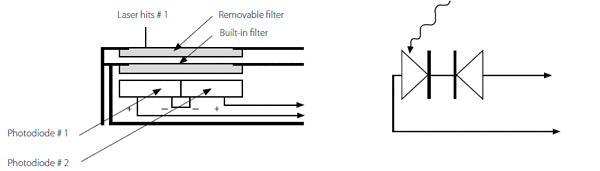
Commonly used laser power sensors include: photodiode sensors and thermal power sensors. Photodiode sensors are used for low power ranging from fractions of nanowatts up to several hundred milliwatts and up to 3W. Thermal sensors can be used for fractions of microwatts to tens of thousands of watts. Thermal sensors can also measure single-shot energy at pulse rates of no more than one pulse every 5 seconds.
Laser Photodiode Sensor:
Photodiode sensors are highly linear over a wide range of optical power levels: from fractions of nanowatts to about 2mW. Above this light level, corresponding to a current of about 1mA, the sensor saturates and incorrectly reads low. Therefore, most laser photodiode sensors have built-in and removable attenuators that can measure up to 3W without saturation.
Laser Thermal Power Sensor:
Thermal sensors have a series of bimetallic junctions called a thermopile. The voltage generated by the radial or axial heat flow through the sensor is proportional to the power absorbed when flowing through the thermopile. The reading does not depend on the ambient temperature because only the temperature difference is measured rather than the absolute temperature. The thermopile elements are arranged such that the reading is almost independent of beam size and position.
P.S. Luftmy laser sensor application fields: air purifiers, air conditioners, PM2.5 detectors, range hoods, smoke alarms, fresh air systems, dedicated PM2.5 sensors, air detectors, wearable devices, etc.