

Technical Support:
158-7527-1139

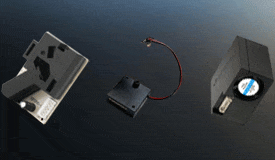
For PM2.5 detectors, the sensor is the foundation of the device. The quality of the sensor determines the working quality and performance of the finished detector. As the "eyes" of the detector, the sensor can quickly detect and react to air quality conditions and provide timely feedback to users.
Currently, the most common PM2.5 sensors on the market are mainly divided into infrared probes and laser probes. The principle of the infrared dust sensor is to use visible infrared light to analyze and identify particulate matter with a diameter of more than 0.5 microns, and calculate the particulate concentration through a light scattering algorithm. One difference between infrared dust sensors and laser dust sensors is that there is no fan inside the infrared dust sensor. The airflow is passively circulated, relying on resistor heating to drive the airflow, resulting in relatively small airflow and data volume. The laser dust sensor has a built-in fan that can actively inhale airflow, providing stable airflow and obtaining a larger volume of air.
The laser particulate matter sensor can obtain the accurate concentration of particulate matter with a diameter of 0.1-2.5 microns in the air per unit volume. Generally, the wavelength of ordinary red laser light is 630-650 microns, and the half-wave diffraction is 630-650 nanometers. Particulate matter larger than 300 nanometers (i.e., 0.3 microns) can be accurately detected.
