

Technical Support:
158-7527-1139

With the continuous development of industry and transportation, large amounts of harmful substances are discharged into the air, changing its normal composition and deteriorating air quality. Our health is affected when we live in polluted air.
To improve ambient air quality, prevent ecological damage, create a clean and suitable environment, and protect human health, China formulated the "Ambient Air Quality Standards" (GB3095-1996) based on the "Environmental Protection Law of the People's Republic of China" and the "Law of the People's Republic of China on the Prevention and Control of Atmospheric Pollution."
This standard specifies the classification of ambient air quality functional zones, standard levels, major pollutant items, and the concentration limits of these pollutants at each level, serving as the scientific basis for evaluating air quality.
Classification of Ambient Air Quality Functional Zones:
Class I zones are nature reserves, forest areas, scenic spots, and other areas requiring special protection;
Class II zones are residential areas, mixed commercial/traffic/residential areas, cultural areas, general industrial areas, and rural areas as defined in urban planning;
Measuring whether the air quality of a certain area reaches a certain level mainly depends on whether the concentrations of various pollutants such as inhalable particulate matter (PM10), sulfur dioxide (SO2), and nitrogen dioxide (NO2) meet the corresponding standard levels.
Classification of Ambient Air Quality Standards:
Class I zones implement Grade I standards;
Class II zones implement Grade II standards;
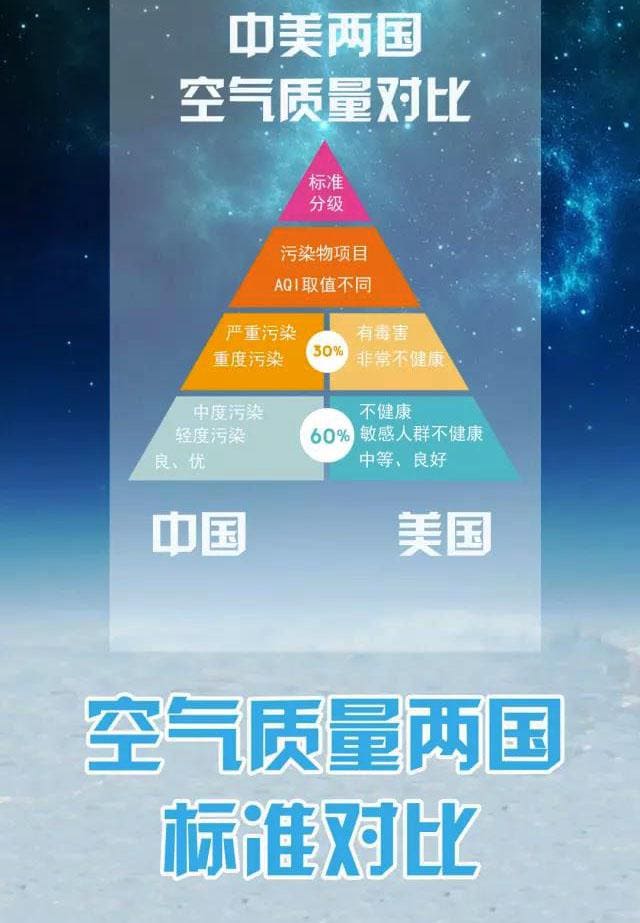
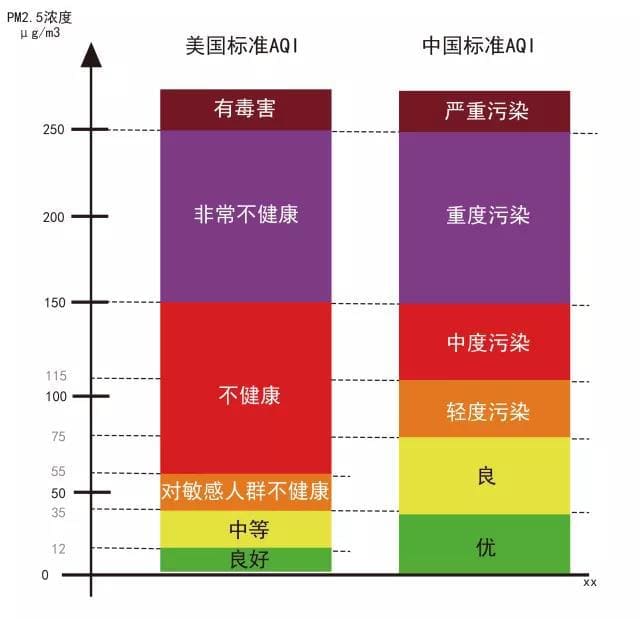
Air quality standards formulated by different countries vary, and AQI ranges also differ. China adopts a standard similar to the United States, with the AQI range between 0 and 500.
Our model assumes the primary air pollutant is PM2.5. The following figure intuitively shows the difference in AQI calculated according to Chinese and American standards under the same PM2.5 concentration level.
As shown below:
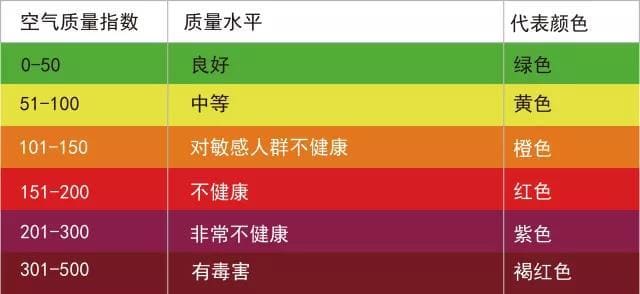
Different AQI value ranges represent different air quality levels. For example, 0-50 represents "Good"; 51-100 represents "Moderate"; 101-150 represents "Unhealthy for Sensitive Groups", etc.
For better visualization, each range has a fixed color corresponding to it. Thus, the air quality level can be intuitively judged based on the reported AQI value or even just the color.
As shown below:
P.S. Luftmy laser PM2.5 sensor application areas: air purifiers, air conditioners with purification functions, PM2.5 detectors, range hoods, smoke alarms, fresh air systems, dedicated PM2.5 sensors, air detectors, wearable devices, etc.
